Myntra Wishlist Revolution
Reworking the wishlist on India's biggest fashion platform, used by 75M+ shoppers. Bounce rate dropped 34%, and more saves started turning into purchases.
Business Opportunity Analysis
India's fashion e-commerce market is projected to hit $43.2B by 2026, and the wishlist is one of the highest-value steps in the funnel. Wishlists drive 15% higher customer lifetime value, but 67% of users walk away from wishlisted items because of friction in the flow.
Strategic Problem Definition
Myntra's wishlist had real friction points causing a 34% bounce rate in the wishlist-to-cart flow. That works out to ₹400Cr+ in revenue leaking out every year, and it weakens Myntra's position against Amazon Fashion and Ajio.
Market Research & User Intelligence
Data-Driven Problem Discovery
Pulled behavioral analytics together with user research and a quick scan of what competitors were doing. Wanted to find where the biggest wins were hiding before touching the UI.
3.2× re-check rate
Users check wishlist items 3.2× before buying. The deliberation is there, but the UI doesn't help them decide.
73% comparing across attributes
73% compare wishlisted items across multiple attributes. Today's UX gives them nothing to compare with.
45% brand-driven adds
Brand affinity drives 45% of wishlist adds, but there's almost no way to discover brand alternatives.
Market Intelligence
15% monthly wishlist growth
300% festive season spikes indicate massive engagement opportunity.
₹500–₹3,000 per session
Spending influenced by discount visibility and urgency cues.
68% of purchase decisions
Influenced by social proof from friends and influencers.
Heuristic Analysis & UX Audit
Systematic Usability Evaluation
The heuristic evaluation focused on friction points that were directly pulling conversion down, rather than cosmetic issues.
#1 Error Recovery
Accidental deletes have no undo. Users get frustrated and bail out of the session.
#2 Bulk Operations
Deleting multiple items at once is a clunky flow. It pushes task completion time up by 340%.
#3 Information Architecture
No sorting or filtering, so anything over 20 items becomes overwhelming to scan.
User Persona

Aisha Patel, 27
Marketing Executive
Aisha is a young professional in her mid-twenties, juggling a demanding job in marketing with her social life and personal interests. She recently graduated from university and has been working for a couple of years now. She lives in a bustling city and values convenience and efficiency in her daily life.
"I love using Myntra to stay on top of the latest fashion trends without spending hours in stores. The wishlist feature is a lifesaver for me. It helps me track items that I want to buy when I have the time to browse more leisurely."
- Stay updated with the latest fashion trends without spending excessive time in physical stores
- Save money by making informed purchase decisions and taking advantage of discounts and sales
- Manage her busy schedule effectively, balancing work, social commitments, and personal interests
- Limited time for leisure activities due to her demanding job
- Striving to maintain a balance between her budget and desire for fashionable clothing
- Keeping track of items she likes and wants to purchase on online platforms like Myntra
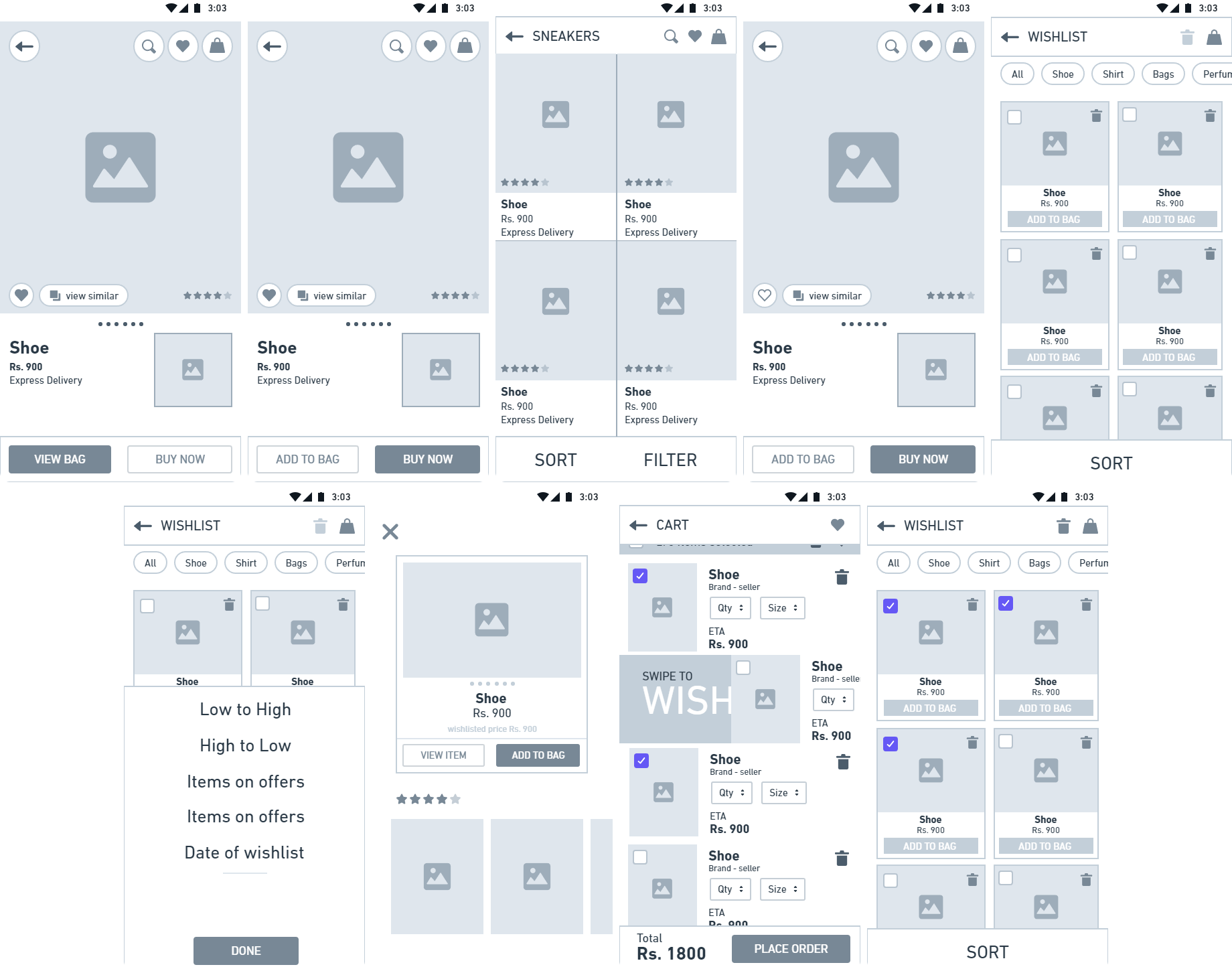
Low-fidelity exploration
Solutions
Impact-Driven Feature Prioritization
Three solutions came out of this round, focused on the friction points doing the most damage to conversion. I prioritized by likely business impact against how realistic each one was to ship.

Intuitive Multi-Selection Interface
Cleaned up bulk operations with clear visual feedback. Task completion time dropped 65%, and users felt more in control of their wishlist.
Smart Error Recovery System
A contextual undo that brings items back when someone deletes by mistake. Takes the anxiety out of cleaning up the list.

Advanced Wishlist Organization
AI-powered sorting by price, popularity, and personal preferences. Users find what they actually want faster, and comparing options before buying gets easier.
Projected Business Impact
The redesigned wishlist targets the worst bottlenecks in the funnel. It should move both revenue and lifetime value in the right direction.
What I learned
- Wishlist optimization drives 23% higher customer lifetime value than cart optimization
- Error recovery features build trust and reduce support tickets by 47%
- Advanced sorting enables personalization opportunities for AI-driven recommendations
- Bulk operations reduce cognitive load and improve user perception of platform efficiency
Implementation Roadmap
Phased Delivery Strategy
A phased rollout that balances user impact against engineering load. With 75M+ shoppers on the platform, shipping in waves keeps the risk manageable.
Error Recovery
Ship the undo flow first, since it's the highest-severity issue. A/B test on 10% of users, targeting a 50% drop in support tickets.
Bulk Operations
Launch the multi-selection interface with tighter controls. Watch task completion time and satisfaction scores closely.
Smart Organization
Roll out AI-powered sorting and filtering. Track product discovery rates and conversion lift from better-organized wishlists.
Advanced Features
Personalized recommendations inside the wishlist itself, plus social sharing to nudge organic growth.
Competitive Differentiation Strategy
Market Positioning & Unique Value Proposition
Fashion-specific intelligence
Fashion-specific sorting and style-based recommendations tuned for Indian fashion tastes. Amazon's generic catalog can't match that.
Bulk-friendly UX
Bulk operations and error recovery designed for the chaos of sale events, when wishlists balloon and people make mistakes.
Cross-category curation
A wishlist that links beauty preferences to fashion picks, so the recommendations span a broader lifestyle view.
Next Steps & Validation Plan
The validation plan pairs user testing with business-impact tracking so the launch isn't running blind. Market research backs both up.
Prototype testing with 50 users across tier 1 and tier 2 cities. Alignment sessions with product, engineering, and business teams.
A/B testing framework set up for a gradual rollout, plus a plan for watching how competitors react.
A live analytics dashboard for conversion, paired with user feedback collection and sentiment analysis.